
Portal latinoamericano de toxicología
Not-so-simple green: Researchers examine the dark side of called green products
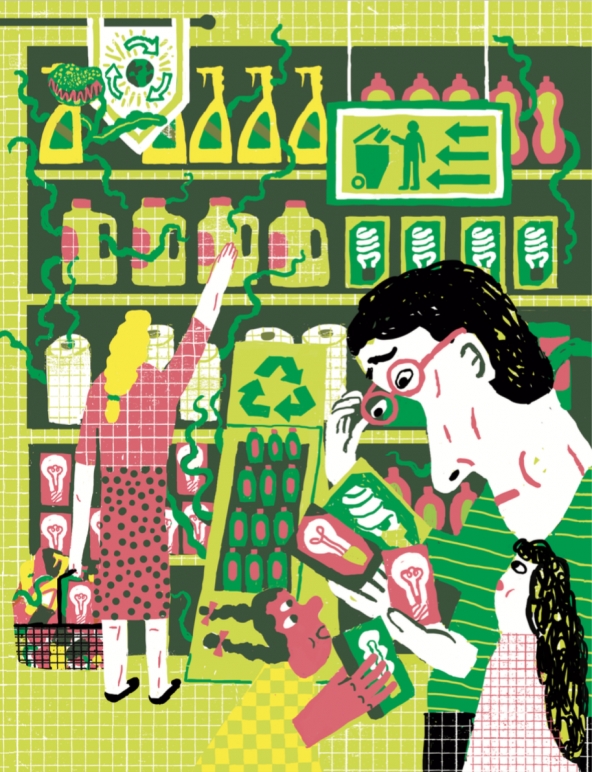 (Illustration by JooHee Yoon)Let’s first take a closer look at the current thinking about green products. Most managers realize that virtually all products and services have environmental impacts, just as they have economic costs. In other words, practically all products and services require the extraction of natural resources and cause the release of wastes and emissions, and both these activities are almost certain to affect the natural environment adversely. The environmental benefits of green products are not that they somehow fix the environment or have zero impact, but rather that their environmental impacts are less than those of similar products.
A whole new profession has sprung up that has become ever more sophisticated in making these so-called attributional life-cycle assessments (LCAs).1 LCAs result in a set of environmental impact indicators per product. When this analysis is used, product A is deemed greener than product B if it has lower indicator results than product B. All we need to determine whether a product is green is a benchmark product, which defines the amount of environmental impact that is typical or average. A product is called green when its life-cycle environmental impacts are lower than those of the benchmark.
This is the state-of-the-art thinking about green products. In fact, many managers and management scholars have a much cruder approach to greenness. Frequently, they simply look for one product attribute that can be labeled green and call a product green if it scores high in this attribute. This way bio-based materials (such as clothes made from natural fibers), products with recycled content, and hybrid cars are labeled green products even without genuine analysis. LCA, with its life-cycle perspective and multiple environmental indicators, is clearly an improvement over such simplistic thinking. Unfortunately, even adding life-cycle thinking cannot save the fundamentally flawed concept of the green product.
There is an alternative approach that avoids these problems and gives us a much better idea of the overall impact that a product or business activity has on the natural environment. We call it “net green,” because it calculates the net impact on the environment, after accounting for all factors, including the impact that the product or service has on markets and consumer behavior. We will explore net green in more detail later in the article, but first it’s important to understand the limitations of the popular idea that products themselves can be green.
The Elusive Benchmark ProductThe trouble with green products starts with the seemingly commonsense idea that greenness can be determined through comparison to a benchmark product. LCAs would help you conclude that a hybrid SUV is indeed greener than a conventional, equal-sized SUV. But the customer might actually choose the hybrid SUV instead of a conventional compact car with higher fuel economy. The benchmark idea can be just as problematic for intermediate goods. An example would be a utility that chooses electricity from natural gas over renewable electricity, and not over coal-based electricity as is typically assumed. Suddenly, the hybrid SUV and electricity from natural gas are not green any more.
You may contend that these examples demonstrate that the benchmark product needs to be chosen carefully, but the problem runs deeper than that. It can be argued that packaging made from recycled plastic is green compared to identical packaging from the primary polymer. But a consumer may buy produce in recycled plastic clamshells instead of buying it without any packaging at all. The benchmark would now be no packaging at all, which means that no packaging could possibly be green. Could this example just be a minor exception? We’re afraid not.Imagine someone buying a refurbished cell phone (or any other refurbished electronic device) in addition to, rather than instead of, a new one, say as a backup device.2 Or picture someone buying the refurbished product because she cannot afford a new one. What about someone who buys a brand new, very energy-efficient gadget, not instead of a less energy-efficient gadget, but instead of no gadget at all? Maybe the advertised greenness of the energy-efficient gadget even encouraged the consumer to purchase it instead of not buying anything.At this point we feel compelled to share the story of a company in the business of making franchise toys for children’s movies—think plastic replicas of superheroes, princesses, cowboys, astronauts, and Stormtroopers. An animated movie with a deep environmental theme was being made, and the toy company asked us whether making the franchise figurines from recycled plastic would make them green. We felt unable to answer the question meaningfully. In the end, the foundation that licensed the story to the film studio decided to not have any franchise toys at all, confirming the suspicion that there was no meaningful benchmark product to determine the greenness of the proposed recycled plastic franchise figurines.
Green Products That Grow Market DemandThe examples where the correct benchmark seems to be no purchase at all overthrow the naïve assumption at the core of the green product idea, which is that each product category has a constant or at least predetermined sales volume, and customers simply choose among the alternatives within the category. That the problem goes far beyond choosing benchmarks can be illustrated with a close examination of the mother of all green activities: recycling.
How could recycling possibly be bad for the environment? First, let’s recall the mechanism by which recycling generates environmental benefits, using metals as an example. Recovering metal scrap from discarded products and turning it into secondary (recycled) metal has, of course, its own environmental impacts. Nevertheless, LCAs show that those impacts are much smaller than those of producing the metal from primary resources, that is, ores. If increased production of recycled metal generates an equal decrease in primary metal production, total environmental impact is reduced. So a product made from recycled steel, aluminum, or copper should clearly be greener than a benchmark made from primary steel, aluminum, or copper. Well, not according to the metal industries.
The metal scrap markets, argues the industry, are constrained by supply rather than demand. Therefore, increasing the recycled content in your product will just force someone else to use primary metal instead, because there is not enough scrap supply for both of you. As your environmental impact goes down, someone else’s goes up by the same amount. Therefore, the only way to decrease overall environmental impact, so all major metal associations have us believe, is to increase the supply of scrap.3 A metal-containing product is thus green if and only if it is recycled at the end of its life. Recycled content doesn’t matter.
Chew on this for a bit. It gets worse.The argument above is essentially about whether increasing scrap demand or scrap supply leads to higher levels of recycling. It has plagued LCA practitioners and users for more than 20 years. What all agree on, however, is that every kilogram of recycled metal avoids the production of one kilogram of primary metal, given that they are technically equivalent. Again, the assumption behind this belief is that market size is given and fixed. Increasing secondary material production therefore must decrease primary material production by an equal amount. Unfortunately, this is unlikely to be true.
Let’s assume for a moment that the scrap market is supply constrained because recycled metals have a cost advantage over primary metals, which would make scrap desirable. This could be seen as a beautiful example of the holy grail of corporate environmental sustainability, a win-win situation with double dividends, economic and environmental. But basic microeconomics also tells us that being able to produce and sell a commodity at a lower price than your competitors will bring the overall price of the commodity down, which in turn will increase the demand for it. In other words, recycling metal scrap may not just reduce primary metals production, but also grow the overall size of the metals market.4 This is good news for the metal industries, but bad news for the environment.
To be clear, we are not saying that recycling is bad for the environment, but that it is almost certainly not as good as you think. To summarize: The controversy over recycled content makes the choice of a benchmark product difficult enough. The fact that recycling may grow the market rather than displace primary metals production one-to-one makes it meaningless.
Green Products That Increase ConsumptionWe would like to point out an emerging theme. What makes the notion of a green product so elusive is that introducing or offering a green product not only makes certain consumers switch from a well-known benchmark to the green product, but can have all sorts of other unintended market effects. Not only can it increase the product’s market size, but it can even increase the rate at which the product itself is used. Probably the best-known example of this phenomenon is the so-called “direct rebound effect” of fuel-efficient vehicles.This is how the direct rebound effect goes: The owner of an old SUV with poor gas mileage gets the brand-new hybrid version with improved fuel economy, clearly a green version of the old car. In the green product narrative, the owner drives a fixed number of miles every year, so the hybrid car will reduce gasoline consumption and all related emissions. It will also save the owner money. There is, however, considerable evidence that the owner will use some of the savings to drive more (for instance, taking a job that is farther away from where she lives, or moving farther away from her job).5 The larger this so-called direct rebound effect is, the less green is the hybrid vehicle.
The logic of the direct rebound effect applies not only to cars, but to all products that consume energy during their use. Another example is the use of light-emitting diodes (LEDs) to reduce energy consumption and related environmental impacts from lighting. The breakthrough invention of the blue LED (necessary to create white LED light) earned scientists Isamu Akasaki, Hiroshi Amano, and Shuji Nakamura the 2014 Nobel Prize in Physics. The Nobel committee hailed the LED as a “fundamental transformation of lighting technology,” stating that because they are energy-efficient, “LEDs contribute to saving the Earth’s resources. Materials consumption is also diminished as LEDs last up to 100,000 hours, compared to 1,000 for incandescent bulbs.”6
As you may have expected, there are plenty of attributional LCAs comparing LED lighting to incandescent or fluorescent lighting. They all show that indeed LED lighting is the greenest source of artificial lighting, measured in lumen-hours.7 But historical analysis of artificial lighting shows that total consumption has increased dramatically as the cost of lighting has decreased.8 Other studies suggest that lighting demand in both developed and developing nations is far from being saturated, and that further decreases in the cost of lighting will undoubtedly lead to high levels of rebound, as users will leave lights on longer, illuminate more areas, buy larger lit products (such as flat-screen TVs), and find whole new applications for lighting (think, for instance, of the rapidly proliferating touch-operated LED-screen soda fountains).9 This could even lead to what is called “backfire,” the situation where the increase in lighting consumption outweighs the increase in lighting efficiency and leads to a net increase in electricity consumption and related environmental impacts.
Unfortunately, if backfire occurred, it would not make lighting an outlier. A recent study of ten industrial activities showed that, over the decades, growth in consumption outpaced efficiency improvements in every case.10 (The ten activities studied were production of pig iron, aluminum, and fertilizer; electricity generation from coal, oil, and natural gas; travel by rail, air, and motor vehicle; and residential refrigeration.) A product that reduces environmental impact per unit service but increases total environmental impact should not be called green despite its apparent eco-efficiency.
Net Green To The Rescue
We define net green thus: A business activity is net green if and only if it reduces overall environmental impact. Although this statement sounds straightforward, implementing it is not trivial, as our discussion of the elusive green product has shown. One good thing about the net green concept is that it applies not just to selling products, but to any business activity—and because a business is at some level simply a collection of activities, net green can be used to evaluate entire businesses as well.
To illustrate the power of this seemingly simple concept, we will now apply it to a business model that is commonly thought of as green: car sharing. Car sharing, championed by companies such as Zipcar, Flexcar, and RelayRides, is a business in which subscribing members can use cars on an hourly basis in cities and metropolitan areas. Car sharing is different from car rental in that it is meant as an alternative to owning a car. Selling services instead of products is one of the mantras of corporate environmental sustainability, and it is seen by many as green even without any rigorous analysis. Typical arguments for the greenness of car sharing include vague assertions that it is more efficient, and slightly more defensible claims that it reduces the total number of cars, such as Zipcar’s statement that “each and every Zipcar takes 15 personally owned vehicles off the road.”11
Is Car Sharing Net Green?To determine whether car sharing is net green, we need to first identify and then quantify the ways in which car sharing causes changes in environmental impact. For cars and all other types of transportation, the lion’s share of environmental impact happens during their use, not during the production of the vehicles. The impact of transportation use is determined by the distance traveled and the efficiency of the transportation mode. Alternative and public transportation modes are typically more efficient than private cars.
There are four types of changes car sharing can effect in the transportation behavior of its users. First, joining a car-sharing service can lead users to increase or decrease their amount of car travel. Next, the shared cars might have higher or lower fuel efficiency than the cars owned by its users. Third, car sharing can change the mix of transportation modes used by their members and the frequency with which they use them. And fourth, car sharing can affect the total number of cars produced and sold, as claimed by Zipcar. In principle, the environmental impact of each of the four effects could be positive or negative. To determine whether car sharing is net green requires us to estimate the direction and size of each effect.
Luckily, a team of researchers from the University of California, Berkeley, investigated most of these questions by surveying the changes in travel behavior of more than 6,000 car-sharing users before and after joining a car-sharing service.12 The survey results show that the majority (58 percent) of car-sharing users were previously carless and joined car sharing to gain access to personal automobiles. These users thus shifted from more efficient public and alternative transportation modes to less efficient cars. They also generally increased their total travel, though not by a large amount (typically less than 620 miles per year). As a result, the majority of car-sharing users actually increased their environmental impacts from transportation, but only slightly.
On the other hand, a minority (17 percent) of car-sharing users sold, donated, or retired one or more cars after joining car sharing. These users made a moderate shift toward public and alternative transportation, and, most important, they reduced the miles they traveled in cars as well as their overall amount of travel. These mileage reductions were typically much more dramatic than the increased car use of the previously carless majority. As a result, the car-shedding minority of car-sharing users created large reductions in the environmental impacts of their transportation activities. Because the travel reduction by car-shedding users was large and the travel increase by previously carless users was small, car sharing (after averaging over all users) was found to reduce vehicle travel by more than 1,700 miles per user per year.
Two secondary factors further enhance the net greenness of car sharing. First, shared cars are, on average, more fuel efficient than the cars owned by car-sharing users. The University of California, Berkeley, survey finds an average difference of 10 miles per gallon, increasing fuel efficiency from 23 to 33 mpg. This does not come as a big surprise, because car-sharing companies include the gas in the price of the rental and therefore have a financial incentive to use a fuel-efficient fleet.
The second factor is that car sharing does indeed reduce the number of vehicles as Zipcar claims, but not in the way Zipcar thinks. Zipcar counts all cars that car-sharing users sold after joining, or would have bought if they had not joined car sharing, as cars taken off the road. This method of counting ignores that sold cars end up on the used car market and are therefore still on the road, and that some of the forgone cars would have been used cars, too. The real mechanism by which vehicle production is avoided is that car sharing reduces the miles users travel in cars, which means that fewer cars are needed to meet aggregate transportation needs. Recognizing this decrease, we have independently estimated that every shared car avoids the production of just over half a car.13 This is much less than the 15 cars that Zipcar estimates, but still significant.
Most of the change in environmental impacts from car sharing comes from changes in distance traveled by car-sharing users. Therefore, one of the critical insights from this example is that the service of car sharing cannot be deemed green or not green on its own. Whether car sharing is green is not an attribute of the service itself; it depends on who the customers are, what they would do without the service, and how joining the service changes their behavior. If car sharing attracted only previously carless users, it would increase total environmental impacts. If it attracted only people who shed cars and drive less, it would decrease total environmental impacts.
In the survey results, the travel reductions and efficiency improvements of the car-shedding users outweighed the travel increases and efficiency losses of the formerly carless users, making car sharing net green for the user group studied. It is worth pointing out, however, that this net impact could vary by car-sharing company: A company marketing to and attracting primarily previously carless people is unlikely to be net green. A company attracting many people who will shed cars and drive less, on the other hand, is much more likely to be net green.
The apparel company Patagonia understands this argument better than most other companies. It freely admits that producing and selling garments is still a substantial source of environmental impact. On Black Friday, 2011, Patagonia even took out a full-page ad in The New York Times showing one of its fleece jackets with the headline, “Don’t Buy This Jacket.” Although the underlying reasoning is spot on, the request of the ad is also a great way to put your company out of business. A better approach is to identify net green business activities. Patagonia, for example, has just added garment repair to its business and is about to start selling used products in its stores.
As many companies can attest, advertising products as green has a habit of backfiring. In 2007 the state-run Norwegian Consumer Ombudsman determined that carmakers Toyota, Opel, Mitsubishi, Peugeot Citroen, Saab, and Suzuki had all used misleading phrases to advertise the greenness of their products. Norway has since changed its advertising guidelines, and as a result no car can now be called green, clean, or environmentally friendly.14 We believe that the growing environmental literacy of customers, policymakers, investors, and the public at large will increasingly reward the pursuit of net green and at the same time increase the reputational risks of using unsubstantiated claims of greenness.
The Road to Meaningful Corporate GreeningUntil the global economy reaches a point at which it extracts resources and emits wastes, effluents, and emissions at a pace and in a way that l ie well within the carrying capacities of our planet, meaningful corporate greening means reducing the overall environmental impacts of business activities. This reduction requires a solid understanding, and ideally an actual measurement, of all significant environmental implications of a given business activity, be it a new business model, the launch of a product, a new procurement policy, or an internal cost or waste reduction program.
The popular corporate sustainability strategy of identifying and selling green products is ill equipped to guide companies toward meaningful environmental action, because it ignores the mechanisms by which selling a product—or any other business activity for that matter—reduces overall environmental impact. Instead it naïvely assumes that each green product displaces a product with higher environmental impacts, and that everything else stays the same. This assumption is clearly wrong, and ostensibly green products may actually increase total environmental impact by outcompeting even greener options, increasing total market demand, or increasing product use. Car sharing completely defies the notion that a green product or service has lower life-cycle impacts than a benchmark, because there is no meaningful benchmark at all. Rather, car sharing reduces overall environmental impact by changing the travel behavior of its customers.
The concept of net green, on the other hand, is applicable to selling products, changing business models, developing new business segments, and any other business activity, and it focuses managers’ attention on the actual source of environmental impact reduction. Virtually all business activities have environmental impacts, just as they have economic costs. Net green business activities are those that reduce or avoid other activities that have even larger environmental impact, so that overall impact is reduced. It is the difference between avoided and incurred impacts that is the source of meaningful corporate environmental greening.
Companies that are serious about corporate environmental sustainability need to identify and pursue business activities that are net green. In some instances that may be as simple as displacing a high-impact product with a low-impact one, but frequently it will be more complex than that. In these cases companies need to understand not just their products, but all the other aspects that are affected by their business activities, including those outside their corporate boundaries. For manufacturers of fuel-efficient cars and LED lighting, this means understanding how customers make product purchasing and use decisions and finding ways to reduce the direct rebound effect. Producers and users of recycled material need to make sure that their products displace primary materials rather than grow the total market. Refurbished or remanufactured products need to successfully compete with new products, not just find additional buyers. Car-sharing companies need to attract users who use the service to replace owned vehicles and drive less.
By abandoning the well-intentioned but flawed search for green products and embracing the pursuit of net green, companies finally have a roadmap to becoming part of the solution.
Notes
1 Ana Campoy, “Hot Job: Calculating Products’ Pollution,” The Wall Street Journal, September 1, 2009.
2 Roland Geyer and Vered Doctori Blass, “The Economics of Cell Phone Reuse and Recycling,” International Journal of Advanced Manufacturing Technology, vol. 47, issue 5-8, 2010, pp. 515-525.
3 John Atherton, “Declaration by the Metal Industry on Recycling Principles,” International Journal of Life Cycle Assessment, 12, no. 1, 2007, pp. 59-60.
4 Trevor Zink, Roland Geyer, and Richard Startz, “A Market-Based Framework for Quantifying Displaced Production from Recycling or Reuse,” Journal of Industrial Ecology, published online July 21, 2015.
5 Steve Sorrell, John Dimitropoulos, and Matt Sommerville, “Empirical Estimates of the Direct Rebound Effect: A Review,” Energy Policy, 37, 2009, pp. 1356-1371.
6 “Blue LEDs—Filling the World with New Light,” Nobel Foundation, 2014.
7 Energy Savings Potential of Solid-State Lighting in General Illumination Applications 2010 to 2030, Navigant Consulting, 2010. Harry D. Saunders and Jeffrey Y. Tsao, “Rebound Effects for Lighting,” Energy Policy, 49, 2010, pp. 477–478.
8 Jeffrey Y. Tsao, Harry Saunders, Randy Creighton, et al., “Solid-State Lighting: An Energy-Economics Perspective,” Journal of Physics D: Applied Physics, 43, 2010, p. 354001.
9 Roger Fouquet and Peter J. G. Pearson, “Seven Centuries of Energy Services: The Price and Use of Light in the United Kingdom (1300-2000),” Energy Journal, 27, no. 1, 2006, pp. 139–177. Tsao, Saunders, Creighton, et al., “Solid-State Lighting,” p. 354001. Roger Fouquet and Peter J. G. Pearson, “The Long Run Demand for Lighting: Elasticities and Rebound Effects in Different Phases of Economic Development,” Economics of Energy & Environmental Policy, 1, 2012, pp. 1–24. Andrea L. Hicks and Thomas L. Theis,“Residential Energy-Efficient Lighting Adoption Survey,” Energy Efficiency, 7, 2014, pp. 323–333.
10 Jeffrey B. Dahmus, “Can Efficiency Improvements Reduce Resource Consumption? A Historical Analysis of Ten Activities,” Journal of Industrial Ecology, 18, no. 6, 2014, pp. 883–897.
11 “This Idea Is Bigger Than All of Us, Is It for Me?” Zipcar Inc., 2014.
12 Elliot W. Martin and Susan Shaheen, “Greenhouse Gas Emission Impacts of Carsharing in North America,” IEEE Transactions on Intelligent Transportation Systems, 12, no. 4, 2011, pp. 1074–1086.
13 Trevor Zink, Net Green: The Impact of Corporate Social Responsibility on the Natural Environment and Employee Satisfaction, 2014, ProQuest UMI #3645720.
14 Alister Doyle, “Norway Says Cars Neither ‘Green’ nor ‘Clean,’” Reuters, September 6, 2007.